Labelling Hazardous Chemicals
Every container, every pipe, every decant. Get the label right and most other chemical risks become manageable.
- GHS 7 mandatory for new stock since 1 January 2023.
- 9 GHS pictograms carry most of the visual hazard message.
- Labels in English; product identifier + supplier + Australian phone.
- Decanted containers need a label unless the chemical is "used immediately" (not unattended, single user, container cleaned after).
- Pipework: signs, colour code (AS 1345), or schematic; per Reg 343.
1. Who must label what (Reg 335–345)
Manufacturer / importer (Reg 335)
- Label hazardous chemicals as soon as practicable after manufacture / import.
- Comply with GHS + Schedule 9 of WHS Regs.
- An alternative label is acceptable only if content is the same or substantially the same.
Supplier (Reg 338)
- Must not supply a chemical they know (or ought to know) is incorrectly labelled.
PCBU using / storing (Part 7.1 Subdivision 3)
- Ensure every container in use, handling, or storage is correctly labelled.
- Label chemicals manufactured on site or decanted/transferred at the workplace.
- Maintain labelling while holding the chemical.
Pipework (Reg 343)
- Identified by label, sign, or other means on or near the pipe (so far as reasonably practicable).
- Methods: signs, colour code (cross-reference AS 1345), schematic layouts.
2. GHS — current revision in Australia
- Australia adopted GHS 3 on 1 January 2012.
- GHS 7 transition started 1 January 2021.
- GHS 7 mandatory from 1 January 2023 for new manufacture / import.
- Stock labelled before 31 Dec 2022 under GHS 3 may continue in service; do not relabel.
- New manufacture / import after 31 Dec 2022 must use GHS 7.
3. The 9 GHS pictograms
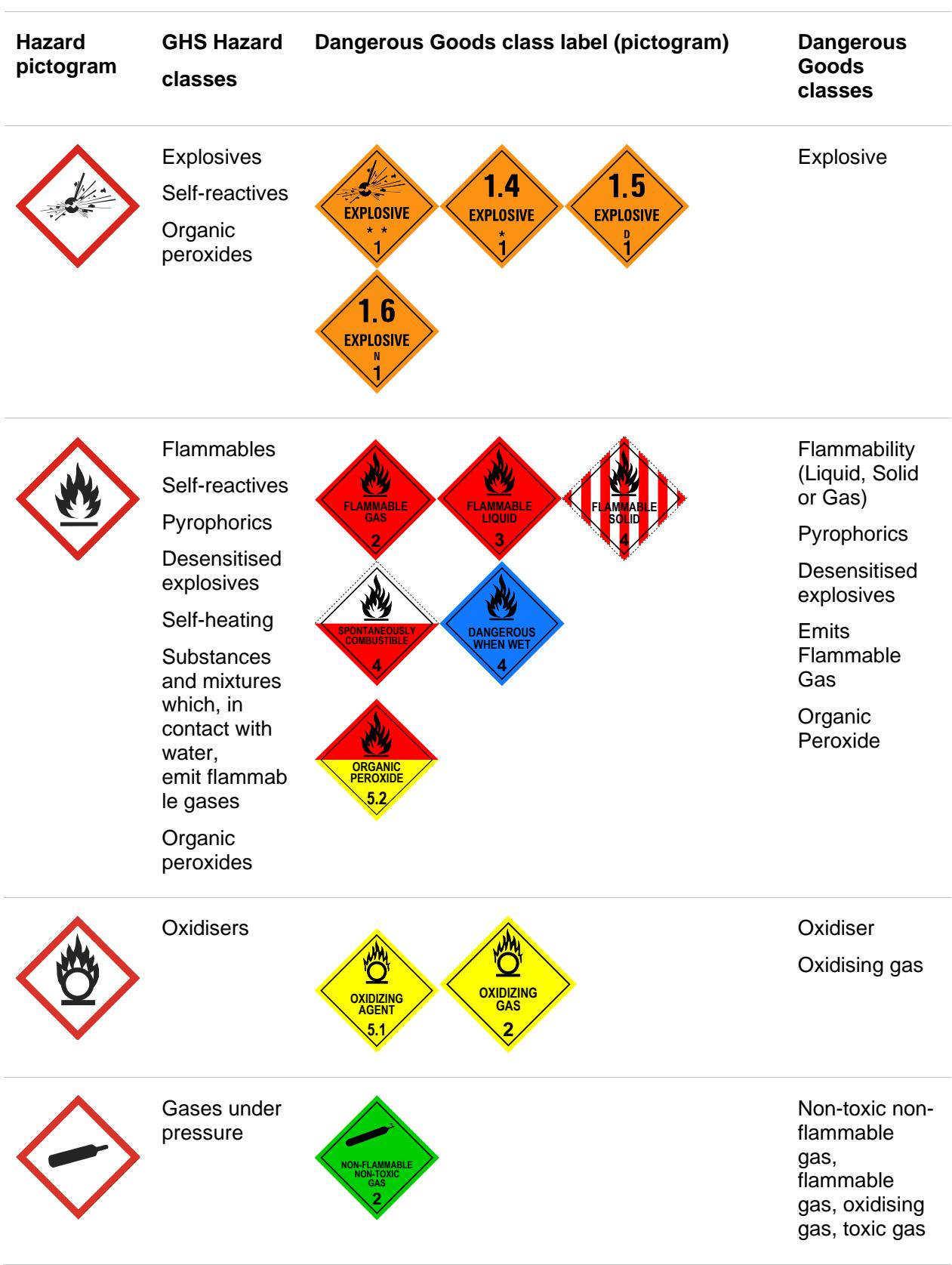 Figure 1 — GHS pictograms vs ADG transport classes (Appendix G of source). The same chemical may carry different pictograms on its workplace label vs its transport label.
| # | Pictogram | Hazard class | Meaning |
|---|---|---|---|
| 1 | Exploding bomb | Explosive | Liable to detonate / deflagrate under shock, friction, heat. |
| 2 | Flame over circle | Oxidising | Intensifies fire; may cause spontaneous ignition. |
| 3 | Flame | Flammable | Liquid / solid / gas catches fire easily. |
| 4 | Gas cylinder | Pressurised gas | Compressed / liquefied; rupture / violent escape risk. |
| 5 | Corrosion | Corrosive | Skin burns, eye damage, material corrosion. |
| 6 | Skull & crossbones | Acute toxicity | Fatal or severely harmful via swallow / inhale / skin. |
| 7 | Exclamation mark | Lesser health hazards | Skin / eye / respiratory irritation; allergic skin; drowsiness; dizziness. |
| 8 | Health hazard (torso) | Chronic health | Carcinogen, mutagen, repro toxin, target-organ, aspiration. |
| 9 | Environment (fish + tree) | Environmental | Acutely / chronically toxic to aquatic life. |
Visual: square rotated 45° (diamond), black symbol on white background, red border, sized to be clearly visible.
4. Required label content (Schedule 9)
Mandatory
- Product identifier (matches SDS).
- Supplier identifier — manufacturer / importer name, Australian address, business phone.
- Ingredients disclosed per Schedule 8 (chemical identity + proportion of each hazardous ingredient).
- Hazard pictograms — all relevant.
- Signal word — Danger or Warning.
- Hazard statements — describe nature & degree (e.g. "Highly flammable liquid and vapour").
- Precautionary statements — prevention, response, storage, disposal.
- Other hazard info — first aid, emergency, anything not covered above.
- Expiry date — if hazard classification changes with degradation.
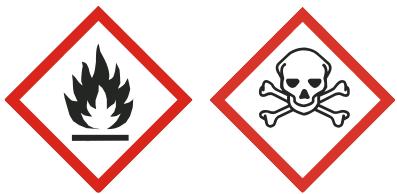 Figure 2 — Worked label example with all required elements: product identifier, supplier, signal word "Danger", flame pictogram, hazard / precautionary statements, ingredients.
Optional but recommended
- 24/7 emergency / poisons phone number (pre-confirmed with the service).
- Overseas manufacturer details.
- Website.
- "See SDS for additional information."
Language: English (mandatory).
Layout: product identifier + ingredients at the most prominent position; signal word + pictograms + statements grouped adjacent.
5. Decanted containers
Decanting = transferring within a workplace (does not include rebottling for supply to another workplace).
Required minimum label (English):
- Product identifier.
- Hazard pictogram OR hazard statement consistent with classification.
"Used immediately" exemption — no label required if all three apply:
- Container not left unattended by the person who decanted it.
- Used only by that person.
- Container cleaned immediately after use.
Repeated-use decant containers — attach a permanent label; never reuse for a different chemical.
If the decant remains for someone else to use, or after a break, or even briefly unattended → label is required.
6. Pipework labelling (AS 1345)
Acceptable methods:
- Signs adjacent to pipework.
- Colour coding per AS 1345 (Identification of contents of pipes, conduits, ducts).
- Schematic layouts displayed prominently.
Information conveyed: identity of chemical, hazards, precautions.
7. Research / lab samples
Minimum label (English):
- Product identifier (chemical name, acronym, formula, structure, or reaction components).
- Hazard pictogram OR statement.
If identity is unknown — state clearly; include best-known / suspected hazard info.
Practical alternatives:
- Secure swing tag.
- Sign on supporting apparatus.
- Outer-container label (one label on a rack of test tubes).
8. Mixtures vs ingredients
- Disclose chemical identity + proportion of each ingredient classified as hazardous (health or environmental) per Schedule 8.
- Not required: ingredients meeting only physical / environmental hazards, or non-hazardous ingredients.
- Generic names permitted (per source Appendix C) where disclosing the true name poses an unacceptable confidentiality / safety risk.
- Mixture's pictograms / signal word / statements come from the mixture's classification, calculated from ingredients per GHS rules.
9. When labels can be omitted or reduced
Reduced label:
- Small containers — too small to fit the full label.
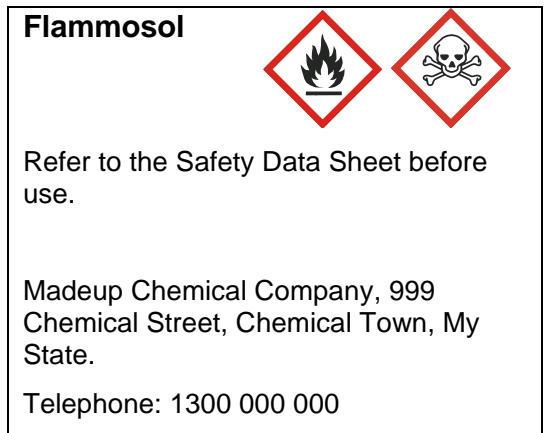 Figure 3 — Small-container label: product identifier, supplier, hazard pictogram OR statement; rest as reasonably practicable.
 - Decanted / transferred — see §5.
- Research samples — see §7.
- Internal-only chemicals (workers know hazards) — minimum: identifier + pictogram or statement.
- Hazardous waste — identifier, manufacturer/importer, pictogram + statement; known constituents and proportions.
Excluded from this code
- Explosives — comply with the Australian Code for Transport of Explosives.
- Ag/vet chemicals — APVMA labelling rules; may omit GHS pictogram + signal word but must include hazard / precautionary statements.
- In transit ≤ 5 consecutive days — transport regulations apply (ADG Code, IMDG, etc.).
- Used immediately (decanted, see §5).
10. Records & training
- Manufacturers / importers retain evidence of correct classification and label content.
- PCBUs maintain labelling on every container while holding the chemical.
- Workers trained to interpret labels and pictograms.
- Decanting workers trained on the "used immediately" rule and the obligation to label otherwise.
- Pipework systems (AS 1345 colours / schematic) require worker familiarity.
11. Common pitfalls / quick wins
Do
- Print "See SDS for additional information" on every label.
- Annual audit — every container (bulk, decanted, waste) for current labelling.
- Identify and replace pre-2023 GHS 3 stock as it cycles out.
- Use Appendix B checklist (8-step label prep) before manufacturing / importing.
- Pipe colour-coded to AS 1345 + reference chart on noticeboard.
- Outer-box labels where individual ampoules are too small.
Don't
- Skip a decanted-container label because "the worker knows what it is".
- Keep pre-2023 GHS 3 labels on stock manufactured / imported after 31 Dec 2022.
- Omit the manufacturer / importer phone — it's mandatory.
- Use ADG-only transport labels in lieu of workplace labels.
- Forget pictogram size (≤ 500 mL: 15 × 15 mm; ≥ 25 L: 100 × 100 mm).
12. Cross-references
- Within §06: managing_risks_of_hazardous_chemicals, safety_data_sheets
- Foundations: risk_management_process
- Glossary (GHS, Schedule 9, ADG): glossary_and_key_concepts
Source: labelling_of_workplace_hazardous_chemicals.md (Safe Work Australia, model Code of Practice, CC-BY-NC 4.0). Last verified against SWA: 2026-04-27.